
This article was written on April 12, 2026. The situation around the Strait of Hormuz and US-Iran relations is moving extremely fast. Some details may have changed by the time you read this — but the core thesis remains.
Most of the coverage around Iran’s Strait of Hormuz toll system has focused on the geopolitical drama — the ceasefire, Trump’s “beautiful thing” comment, the EU’s angry rejection. That is understandable. It is a fast-moving story.
But I think the more important question is being ignored almost entirely.
If this bitcoin hormuz iran toll system becomes real, and if Bitcoin becomes the primary payment method, what does that do to Bitcoin’s supply and demand math?
The answer, when you actually run the numbers, is striking.
This is my personal thesis. The situation is still evolving. But I think the direction is clear enough to be worth laying out now.
What Is Actually Happening
Let me separate what is confirmed from what is still developing.
What is confirmed: Iran passed its “Strait of Hormuz Management Plan” into law on March 30–31, 2026. The IRGC has been charging ships up to $2 million per vessel since mid-March, primarily in Chinese yuan and stablecoins. A Pakistani-brokered ceasefire took effect April 7, 2026, temporarily reopening the strait.
What is developing: On April 8, 2026, the Financial Times quoted an Iranian industry official saying tankers must email cargo details to Iranian authorities, who will then instruct them to pay roughly $1 per barrel in cryptocurrency — specifically mentioning Bitcoin. Trump responded the same day by calling a potential US-Iran joint toll venture a “beautiful thing.”
What is still unclear: Whether Bitcoin is actually being used at scale for these payments right now. Crypto analytics firms including TRM Labs have said they do not yet have on-chain data confirming large-scale Bitcoin toll payments.
So this is still a scenario — but one that is moving toward reality faster than most people realize.
Why Bitcoin Is the Only Logical Choice for Iran
This is the part most analysts are glossing over.
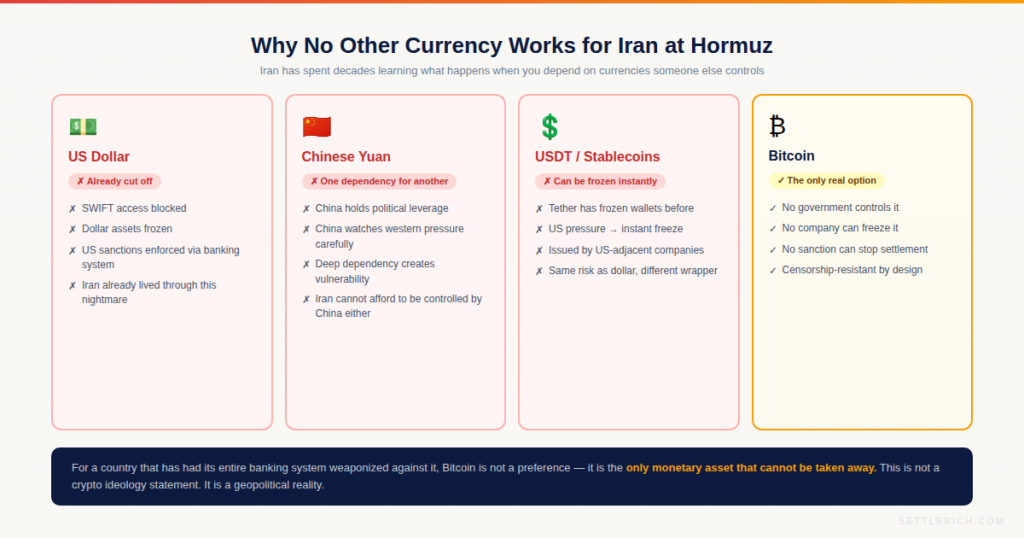
Iran has spent decades experiencing what happens when you depend on currencies that other countries control. The SWIFT banking system was shut off. Dollar-denominated assets were frozen. Even yuan transactions create dependency on China — a relationship Iran cannot afford to make too one-sided.
Stablecoins like USDT sound attractive but carry a critical flaw: Tether has frozen wallets before. The moment the US applies pressure, a stablecoin balance can disappear. Iran has already lived through exactly this kind of financial warfare. They know better than anyone what it means to have your money turned off by someone else.
Bitcoin is different. No government controls it. No company can freeze it. No sanction can stop a Bitcoin transaction from settling. For a country that has been on the receiving end of the most aggressive financial sanctions in modern history, Bitcoin is not just a convenient option. It is the only option that cannot be taken away.
That is why I think, regardless of what the current reports say about yuan and stablecoins, Bitcoin becomes the dominant payment rail for Hormuz tolls if this system persists. Not because Iran prefers it aesthetically. Because it is the only choice that actually protects them.
The Supply Math Nobody Is Talking About
Here is where the thesis gets genuinely striking.
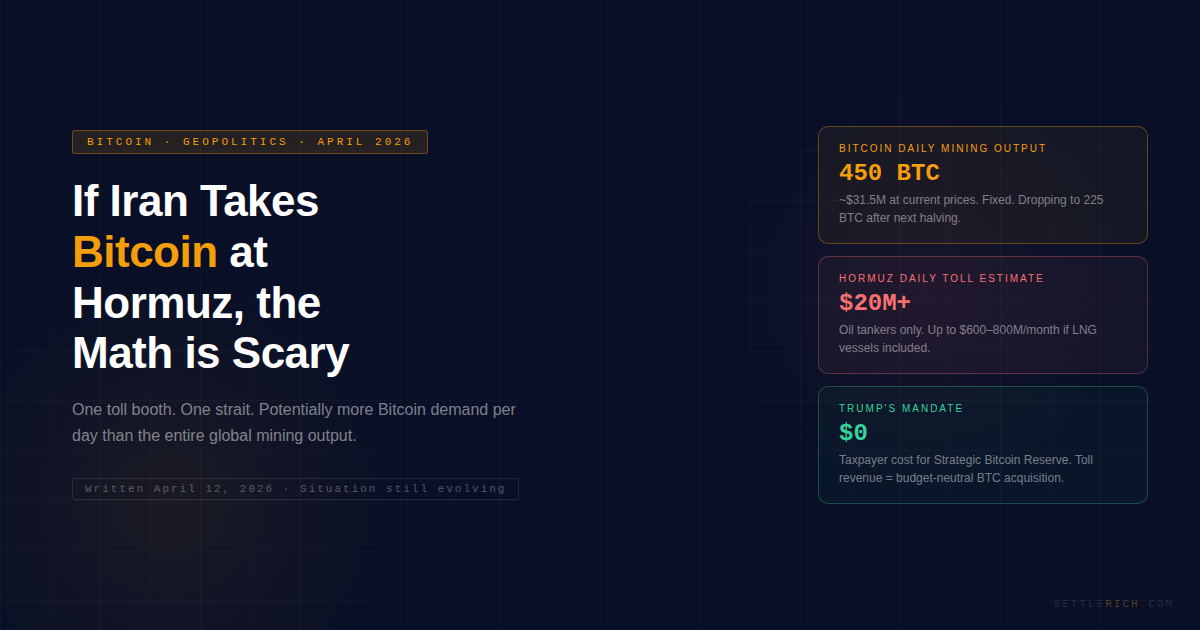
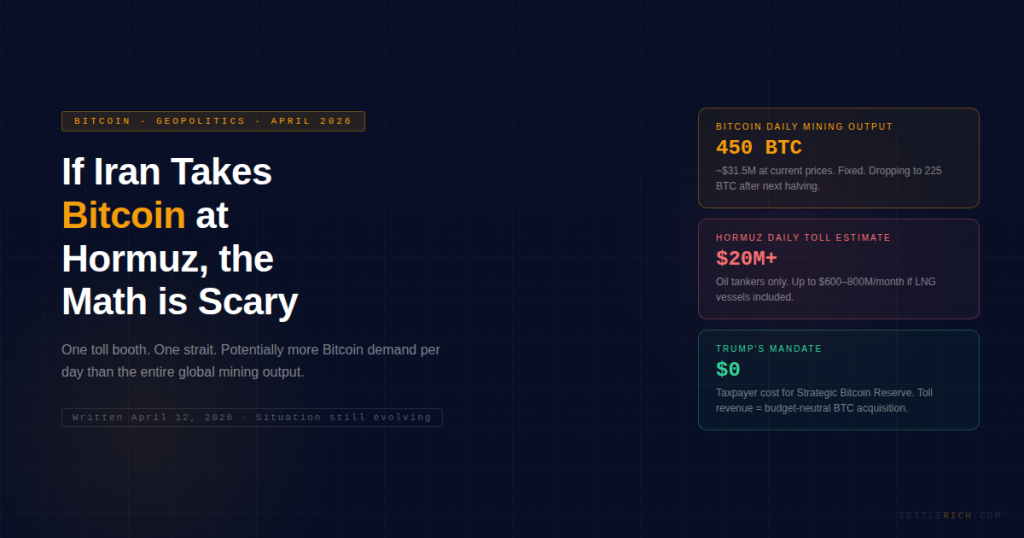
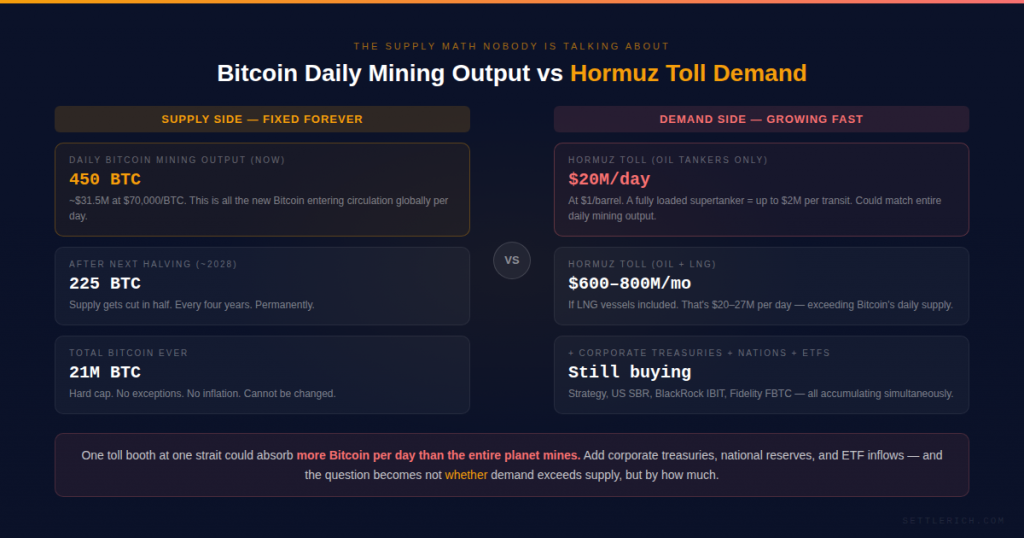
The Strait of Hormuz handles roughly 20% of the world’s oil and LNG supply. Estimates suggest the toll system could generate up to $20 million per day from oil tankers alone, with $600–800 million per month possible if LNG vessels are included.
Now compare that to Bitcoin’s supply side.
Bitcoin’s daily mining output is approximately 450 BTC. At current prices around $70,000, that is roughly $31.5 million worth of new Bitcoin entering circulation every single day.
If Iran collects even a fraction of its estimated toll revenue in Bitcoin, the daily demand from Hormuz alone approaches — and could exceed — Bitcoin’s entire daily mining output.
Think about what that means.
One shipping chokepoint. One toll system. Potentially absorbing more Bitcoin per day than the entire global mining industry produces.
And that is before you add anything else.
Trump’s Hidden Incentive
On March 6, 2025, Trump signed an executive order establishing a Strategic Bitcoin Reserve. The order was explicit: the US would not spend taxpayer money to acquire Bitcoin. Instead, the Secretaries of Treasury and Commerce were directed to develop “budget-neutral strategies for acquiring additional Bitcoin” at no incremental cost to American taxpayers.
That mandate has been sitting there without a clean solution for over a year.
A joint Hormuz toll venture with Iran changes that equation entirely.
If the US participates in collecting tolls at the world’s most important oil chokepoint, and if those tolls are collected in Bitcoin, the US government accumulates Bitcoin without spending a dollar of taxpayer money. It is revenue, not expenditure. It satisfies the executive order’s requirement perfectly.
This is why Trump called the joint venture a “beautiful thing.” Most commentators read that as Trump being flippant. I think he was being precise. A toll arrangement that generates Bitcoin for the US Strategic Bitcoin Reserve, at zero cost to taxpayers, while simultaneously giving the US a formal role in controlling the world’s most important shipping lane — that actually is a beautiful thing, from Trump’s perspective.
The Bigger Picture: Every New Demand Source at Once
Zoom out further and the supply situation gets even more extreme.
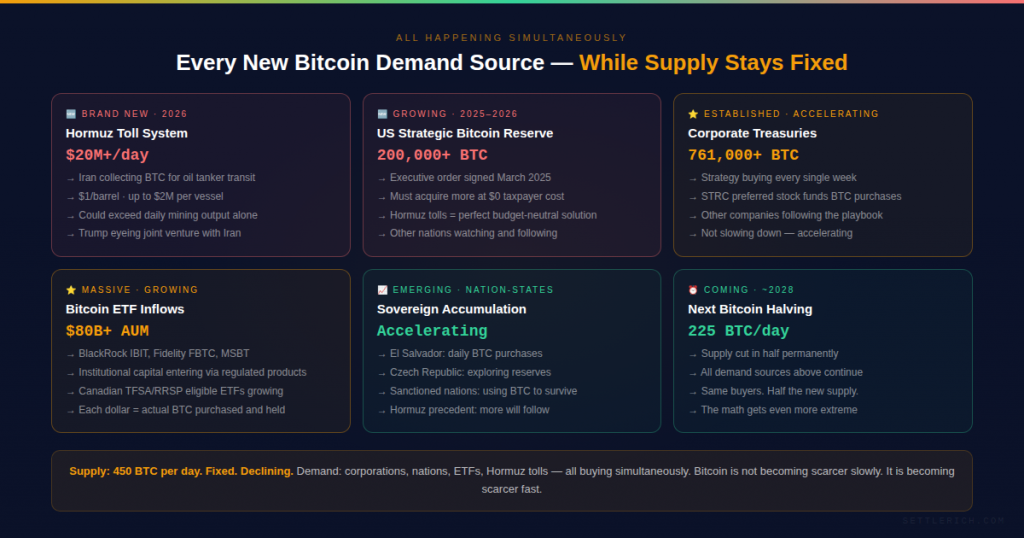
The bitcoin hormuz iran story is not happening in isolation. It is happening at the same time as corporate treasury accumulation, nation-state buying, ETF inflows, and an approaching halving that will cut daily mining output in half.
Strategy holds over 761,000 BTC as of March 2026 and continues buying weekly. The US Strategic Bitcoin Reserve already holds an estimated 200,000+ BTC. Canadian and US-listed Bitcoin ETFs have crossed $80 billion in AUM. El Salvador continues its daily purchases. The Czech Republic has been exploring Bitcoin reserves.
Put all of this together and the picture is clear: Bitcoin is becoming scarcer faster than the market currently appreciates. The Hormuz toll system is not the cause of this — it is one more accelerant added to a fire that is already burning.
Why No Other Currency Works Here
I want to be direct about this, because it matters for the thesis.
The yuan does not work at scale for Hormuz tolls. China holds enormous leverage over Iran, and accepting yuan at this level of volume deepens that dependency in ways Iran cannot afford. The moment China’s interests diverge from Iran’s — which they eventually will — yuan-denominated reserves become a political liability.
Stablecoins do not work either. USDT and USDC are issued by US-regulated companies. Tether has a history of freezing wallets under legal pressure. For a country that has had its entire banking system cut off by the United States, trusting a US-adjacent stablecoin issuer with billions in toll revenue is not a serious option.
Euro, yen, any other fiat currency — all of them flow through correspondent banking networks that can be severed under sanctions.
Bitcoin is the only monetary asset that Iran can receive, hold, and spend without any counterparty having the ability to intervene. That is not a crypto ideological statement. It is a practical geopolitical reality for a heavily sanctioned state.
What This Means for Bitcoin’s Price
I am not going to give a price target. That is not how I think about this.
What I will say is that the structural demand argument for Bitcoin is getting stronger at exactly the moment when the supply is about to get tighter.
If Hormuz toll revenue flows into Bitcoin at scale, that is a new category of sovereign demand that did not exist six months ago. Add corporate treasuries, national reserves, ETF inflows, and the next halving, and you have a situation where the question is not whether demand exceeds supply — it is by how much, and how fast.
The market is still pricing Bitcoin primarily as a speculative asset. The Hormuz development, if it fully plays out, is evidence that Bitcoin is becoming something else: a neutral reserve asset that even adversarial nations are forced to use because nothing else works in their situation.
That transition does not happen overnight. But I think it is happening. And I think the bitcoin hormuz iran story is one of the clearest signals yet that it is.
My Position
I hold Bitcoin through a Canadian-listed ETF in my TFSA, buying a portion of my annual contribution room on a regular DCA schedule. I am not changing my approach based on this thesis — I would hold Bitcoin regardless.
But the Hormuz development reinforces my conviction rather than creating it. When the world’s most sanctioned nation chooses Bitcoin as its sovereign payment rail for one of the world’s most strategic chokepoints, that is not a coincidence. That is Bitcoin doing exactly what it was designed to do.
The supply math is the part that keeps me thinking. 450 BTC per day. One toll booth. One very small strait.
This article reflects my personal views and investment thesis as of April 12, 2026. It is not financial advice. The geopolitical situation described here is evolving rapidly and some details may have changed. Always do your own research before making investment decisions.