
As part of my Ethereum 2026 portfolio strategy, I still hold ETH as a spot position. If Bitcoin is digital gold, Ethereum is something different — it is a digital technology platform that powers stablecoins, decentralized finance, tokenized assets, and a growing share of the on-chain economy.
That does not mean Ethereum is more important than Bitcoin. Bitcoin stands in its own category as the top store-of-value asset in crypto. But Ethereum does not need to surpass Bitcoin to matter. It only needs to remain one of the most important financial networks in the digital asset world.
That is why I still hold Ethereum — and why I think it deserves a place in a serious long-term portfolio.
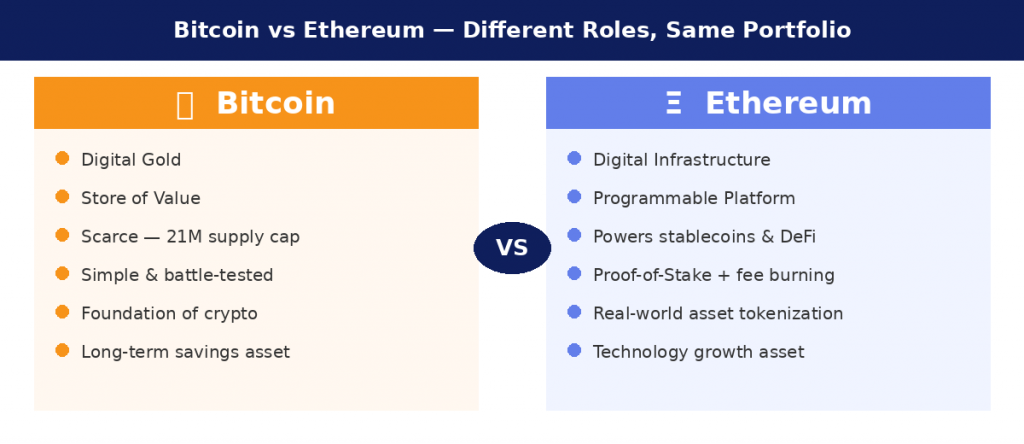
Bitcoin vs Ethereum 2026 Portfolio — Different Roles, Same Strategy
One of the biggest mistakes investors make is treating Bitcoin and Ethereum as if they compete for the same role.
Bitcoin is the foundation. Its appeal is scarcity, simplicity, and long-term store-of-value potential. Ethereum is the platform. It is programmable infrastructure that supports financial activity directly on-chain.
In a portfolio, they coexist — because they do different jobs. Understanding that difference is the first step to building a smarter crypto strategy.
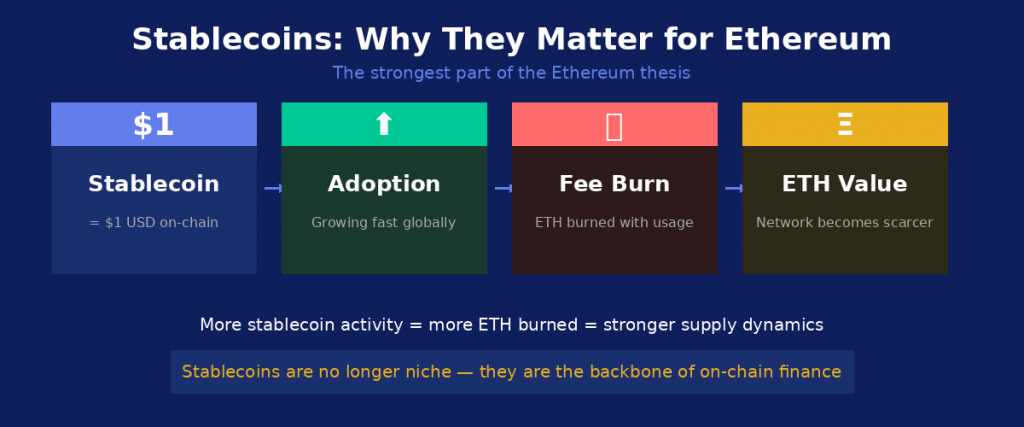
Stablecoins Are the Core of the Ethereum 2026 Portfolio Thesis
The strongest part of the Ethereum story, in my view, is stablecoins.
Stablecoins are no longer niche. They have become one of the most important products in crypto — connecting blockchain networks with real-world demand for dollars, payments, settlement, and liquidity.
If stablecoins continue to grow, the blockchains that support the most meaningful financial activity become more strategically valuable. That is one of the biggest reasons I still hold Ethereum in my 2026 portfolio.
For more on how Ethereum’s proof-of-stake model works, visit ethereum.org
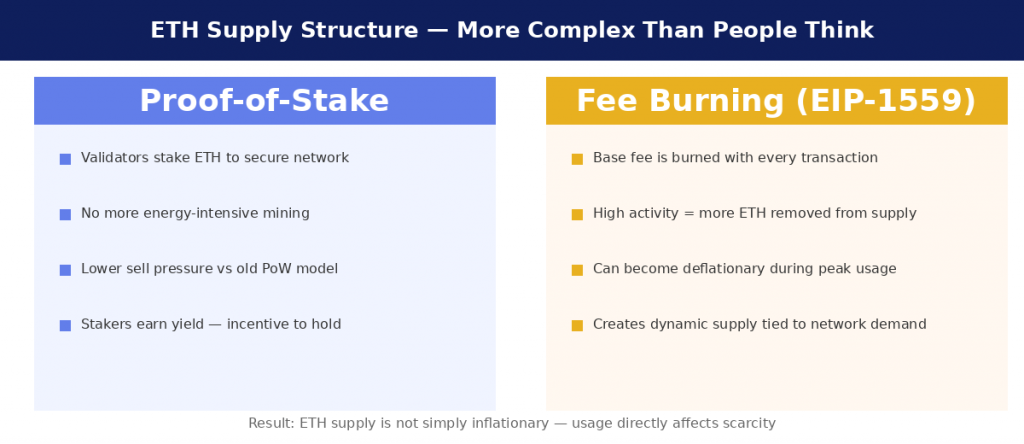
Ethereum 2026 Portfolio — Supply Dynamics Stronger Than Most Think
A lot of investors still describe Ethereum as simply an inflationary asset. That is too simplistic.
Ethereum’s proof-of-stake model and fee-burning mechanism create a more interesting supply profile than most people realize. When network activity rises, more ETH gets burned — which can make the asset deflationary during peak usage periods.
That does not mean ETH is always deflationary. It is not. But it does mean the asset has a stronger long-term supply structure than casual investors assume.
Why This Ethereum 2026 Portfolio Position Still Makes Sense Long-Term
For investors building serious long-term wealth, Ethereum is one of the few crypto assets with a clear fundamental thesis beyond pure speculation.
It powers real financial activity. It has improving supply dynamics tied to actual usage. It remains the most credible smart contract platform in the industry. And I hold it as a spot position — directly, with full conviction.
If you are new to investing in Canada, start with our TFSA guide for newcomers.
Ethereum 2026 Portfolio — The Risks Are Real
None of this means Ethereum is risk-free.
Competition remains serious. Other chains continue to fight for users and developers. There is execution risk — a strong narrative does not guarantee strong price performance on any fixed timeline. And there are ongoing concerns around ecosystem selling and investor sentiment when large holders sell ETH.
These risks do not destroy the long-term case. But they are worth acknowledging honestly. Investing in Ethereum in 2026 requires patience and conviction. It is not a short-term trade. It is a long-term bet on the future of on-chain finance.
My View on the Ethereum 2026 Portfolio
I do not hold Ethereum because I think it will replace Bitcoin.
I hold Ethereum as a spot position because I believe it still has one of the highest probabilities of remaining a core financial network in crypto. If stablecoins keep expanding, if tokenized real-world assets become more important, and if on-chain finance keeps moving toward the mainstream — Ethereum has a strong chance of staying near the center of that trend.
The upside still looks more compelling than the downside.
That is why Ethereum still belongs in my 2026 portfolio — and why I continue to hold it as a spot position.